Off to the Seaside
I don't like formal gardens. I like wild nature. It's just the wilderness instinct in me, I guess.
Walt Disney
On a glorious day we set off for Ringstead Bay, a very wild part of the Dorset coast looking over to Portland. The garden in our sights is set on 4 acres of cliff-side and is approached by a steep, winding path through the blackthorn and alder directly above it and below the National Trust car park.
The owners were certainly up for a challenge when they took this on. They share the plot with badgers, deer and rabbits, which means that any new planting has to be protected by none-too-pretty-looking chicken wire. The salt-laden winds lash to such an extent that the trees take on that particular tapered shape to their tops.
Despite all this, the garden is interesting. Wilderness gives way to tamed woodland and then to relatively flat areas (including a small amount of lawn) around the house. Meandering paths and a series of concrete steps wind between bluebells, hellebore and comfrey planted under specimen trees such as acer and bay (which was flowering beautifully).
One gets glimpses of the ever-present sea between the branches. Facing uphill, the sea becomes the background and the landscape of the garden, the view.
As we toil back uphill towards the car park, we feel we have had a week's exercise, and wonder at the wonderful calf muscles the owners must possess.
Cowden Farm
Supporting people to develop independent working skills
- mission statement, Cowden Farm
www.cowdenfarm.org
Several months ago a brightly painted sign appeared beside the road a couple of miles from the village. It says Cowden Farm. Then, soon after that, a supplementary sign saying Nursery Open. Curiosity drove me to explore what was behind the signs.
Leaving the road, I came to a small car park and beyond it, a poly-tunnel. Inside the tunnel was a good selection of trays of bedding and vegetable plants. I picked out a tray of Iceberg tomatoes and looked for someone to pay. No-one around, so I ventured through a 5-bar gate towards an open door in a farm building. There, a group of about 20 smiling young adults were just finishing lunch. These are the 'customers' of Cowden Farm, who all have some degree of learning difficulty and come here to be taught how to work with animals, to restore furniture, and to become proficient in farm maintenance and organic horticulture.
Having paid for the tomatoes I was sent on my way with words of encouragement such as: 'They will grow really big', 'You must look after them well' and 'They will taste nice'. I'm sure they will!
Out and About in Spring
Behold, my friends, the spring is come; the earth has gladly received the embraces of the sun, and we shall soon see the results of their love!
Sitting Bull
A spell of warm and sunny weather lures us out to see our second NGS (National Garden Scheme) garden of the year. The first was a trip for the snowdrops at Mapperton near Beaminster in mid-February. They were a very welcome sight on the wilder fringes of this elegantly designed garden with its formal structures and punctuations of topiary; this garden looks good at any season.
Today's garden is less grand, but with more
of the human about it. Set in a sheltered south-facing combe in Long Bredy in S W Dorset, the original designer knew just where to put the garden. The sloping site moves from angle to angle, presenting many different faces for planting. A framework of mature trees leaves spaces, which have been developed into areas of lawn, herbaceous border, fruit tree alleys and a walled vegetable garden.
The winter has been continuously damp, but the slopes have ensured that now there is no sign of soggy ground here. The winter has also been very mild, so the spring flowers are well advanced.
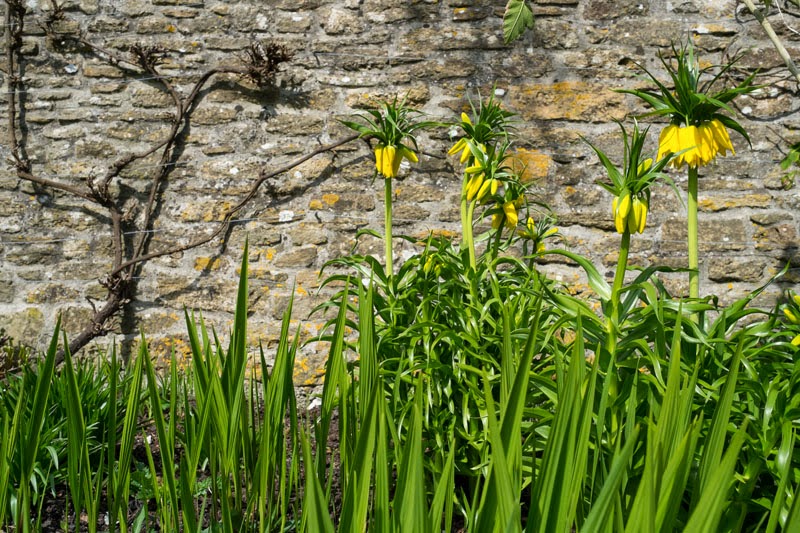
Today the garden was a riot of blue, white, pink, yellow and green, studded with the occasional flash of strong red from tulips and strong yellow from fritillaria imperialis - Crown Imperial. I didn't see any rhododendron or camellia shrub, and I can't say I was sad; they don't thrive on this chalk soil, anyway. The delicate spring flowers have just as much drama and impact.
My highlights were a carpet of anemone blanda in blue, white and pink, studded with cyclamen and interspersed with clumps of narcissus, the emerging buds of cherry on bare branches, an area of wild garlic with white hyacinths placed at regular intervals among it and the bed of broad beans, looking healthy and well-advanced and with a network of string already in place for when the plants need a bit of help staying upright.
Stirrings Mid-March
Consider what each soil will bear and what each refuses.
Virgil
Over a weekend two things have happened that have stirred me from my lethargy and encouraged me to go back in the garden. Some friends in our village in Dorset brought us a big clump of snowdrops dug up straight from their garden. And then we had two days of continuous, warm sunshine.

The garden is still a building site and I struggle over piles of scaffolding to get to the part of the garden that I call flower beds. While the builders have been digging trenches for drains, it has become evident that our garden is on greensand. Since we are surrounded by chalk downs, I had assumed that the soil would be chalky and alkaline; in fact, it is just about neutral. There are shell fossils among the rocks, bearing testament to the fact that this is a soil derived from marine sediment. It is naturally friable and rich in potash. I may have to consider different plants from the ones I had envisaged, but when I go to Google, I only find references to ways to improve the soil by adding potash – I'll do better to ask my knowledgeable friends what they would recommend for planting in this soil.

While I have been absent, the garden has been sleeping and then waking up. Although I have been frustrated by the delay in redesigning the plot, the work done over last year to clear weeds and unwanted plants has paid off and those plants remaining have had a chance to acclimatise. Skeleton heads of last year's flowers of Hydrangea petiolaris still cling to the branches that are now putting out fresh leaves. Lots of signs of pale pink Japanese anemone plants have emerged from under stone slabs, the creeping dead-nettle has taken over the whole space under the Viburnum plicatum, Euphorbia has sprung up, and of course forget-me-nots have seeded themselves in damp, shady patches of soil. I set aside spare Japanese anemones and dead nettle to go into pots to be sold in the village plant fair.

I don't think that we have lost many plants apart from some hellebores. I see them flourishing in nearby gardens, so I suspect that they just got too wet, rather than not liking it here. Of the two camellias in pots, one has a solitary bud forming and the other is covered in buds. I don't know why this should be, but barring a sharp frost or some strong winds, I shall still have plenty to float in bowls for the house in the coming weeks.
Promise
There is a harmony
In autumn, and a lustre
in its sky...
Percy Bysshe Shelley
The garden in France is still a building site,
but it reveals itself in the golden sunshine of a few days in
November. The light filters through the leaves of the large Norwegian
maple which shades the ground where the aconites will be blooming
after Christmas, but which now is covered in stone and plaster dust.
As I remove the annual weeds from the soil
which has just drained after previous rains, flights of storks call
to each other high above, on the way to their winter homes. Forty or
fifty of them in strings, constantly changing position in the air –
absolutely magical companions to an hour or two's gardening. They are
a metaphor for the gardening year: nature moves on to a place where
the new cycle can begin.
I retire to sit by the fire during the dark
months of winter, to think and to plan.
France in autumn
Bittersweet October. The perfect pause between
the opposing miseries of summer and winter. Carol Bishop Hipps
Bittersweet indeed. The anticipation was sweet
...
When we arrived, the air of the courtyard was
thick with dust. The builders were throwing timber, earth and
terracotta tiles out of the windows of one section of the building
and onto the 'flower beds'. They could be excused for thinking that
they weren't spoiling a beautiful garden, since few plants were
flowering, but I think their main concern was to get the dusty job
finished as soon as possible and never mind the impact on the
immediate environment. Then they sat in the shade of the field maple
and filbert trees to clean the tiles, adding mud to the already dusty
earth.
I don't know why I thought I could make a
garden on a building site, but I do know that nature is very
resilient and will recover quickly. The last roses around the edges
of the site are still beautiful, the hazel nuts are ripe and as the
seasons turn, I turn to my drawing board and plans for creating a
grass-free lawn, amongst other things.
France in late summer
'Ah, summer, what power you have to make us
suffer and like it.'
Russell Baker
I had hoped to make a comparison between the
French garden in late summer and in early autumn. However, I became a
bit despondent and stopped writing. This is what I remember.
The end of the summer brought a heatwave in
France and we are were keen to see what the garden looked like in the
sunshine. Steve had pruned the climbing roses – a single crimson
over a stone arch, a single burgundy and a double pink on the walls
that surround the courtyard - and they had put out healthy stems and
flowers. Self-sown buddleia was flowering freely against a
new-rendered wall, doing a good job of softening its edges and
attracting clouds of butterflies. Ever-reliable Japanese anemone and
golden rod stand stately, defying their surroundings. The whole area
is shaded by Norwegian maple and filberts, giving height and shade.
But the flower beds are largely empty now,
with just a few hollyhocks and Echinops still clinging on. Bindweed
had taken hold and the stone paths were obscured by dandelions and
other weeds, so a radical clearing is the only possible choice of
gardening style.