Monday, 27 July 2015

Design and choices


The naturalistic style has come to encapsulate …... imagery of the open countryside. …. It brings us into direct contact with living nature and the processes of seasonal cycles. Michael King


The first thing to say is that I have always been suspicious about the use of grasses in contemporary gardens. I adore the flowery meadows that are now so popular. The look of unimproved grassland, with its succession of flowering plants sprinkled among the texture, with the addition of extra, colourful, natural flowers can be stunning in the right context.


Howev
er, in France we have a courtyard garden, and not a garden that flows naturally into a distant landscape, where this kind of planting is to my mind most appropriate. In most of the consciously designed village and urban gardens that I have seen, where grasses are planted in clumps to edge paths or mixed with flowering plants, it has seemed to me to be a fashion statement rather than an ongoing positive. But my ideas are changing!


I a
m taking my major inspiration from the courtyard garden at Durslade Farm, where one small area is planted in the shade of old farm buildings. This equates much more to our situation than Oudolf Field does, and although I would not expect to reproduce it, I can look closely at the way that the grasses form green shapes and paths and  punctuate the planting. Sesleria autumnalis is low-growing and bright green towards the end of the year, when the flowering plants tend to be losing colour. Deschampsia goldtau throws a feathery spray of seed heads that wave and flutter in the breeze. I will investigate these grasses. Where shall I put them? In structural drifts, is the way I am thinking.


When it comes to the flowering perennials, I need some that appeal to us, are not over-bred and do not need staking. They will be left all though the winter, so they need to keep a good structure or retain seed heads, giving some texture to what might otherwise be rather a barren look. Euphorbia and alchemilla mollis I already have, potted up from seedlings found in the garden in Dorset. Thalictrum, Astrantia, Aster, Echinops, Persicaria, Sanguisorba, Echinacea, Veronica, Salvia. Sedum, Achillia, Geranium, Papava, all spring to mind, but I must be careful to choose the right cultivars. That will be the result of lots of research and then finding which ones can be obtained at a reasonable cost. Many happy hours ahead, with my nose in my books and going down the digital rabbit hole.


Inspiration, and exasperation

"A complicated layering of seasonality, energy, endurance and reward – both before, during and after flowering". Piet Oudolf


I have recently been inspired by the work of Piet Oudolf (Dutch and working internationally, including in Britain) and Michael King (British, but working mostly in Holland). How do I marry my own principles with those of gardeners who are so expert and inspiring?


Having just visited the garden designed and planted by Piet Oudolf for Hauser & Wirth at Durslade Farm in Bruton in Somerset, I am flush with new ideas. The images I have brought back with me have filled my head with possibilities that I hadn't before envisaged in a garden. But how to capture the flavour of them in the garden in France?


So far in our courtyard, which measures 30 meters by 23 meters, I have got to know the feeling of the site during the work of moving all the existing plants to the borders that edge the walls, introducing shade-loving plants into the dinosaur garden and under the trees, and hydrangeas in the lea of a north-facing wall. I am left with a large, existing bed which has been cleared to facilitate the building work and some graveled areas either side of the place where the table is placed when the weather is very hot.


The relevant work of my two current heroes is based on the principle of the flowering prairie. They aim for a natural look, as reflected in nature, but since a garden is not nature, they select plants that will fit with the landscape but not compete with each other. Therefore it is largely perennials that are chosen. The plants should look good throughout the seasons and throughout their life, attracting wildlife and creating mood.


My own wishes revolve round a garden that gives interest at all times of the year (doesn't everyone want this?), shows a purposeful design without looking contrived, fits into its architectural, climatic position and its 'terroir', and will look after itself when we are not there (ha ha!).


My instinct would be to go for a structure of shrubs with coloured annuals and perennials, as in the traditional herbaceous border. I should be a little more imaginative in my approach! How do I marry instinct with inspiration?

Sunday, 19 July 2015

Phew, what a scorcher!

'Ah, summer, what power you have to make us suffer and like it.'
Russel Baker


During the record-breaking high temperatures in England at the beginning of July, most people's gardens were drinking copiously from the hose and deep-breathing to stop from wilting. We were in France, so our garden had to suffer in silence. On our return, we found that, all of a sudden, everything had come together – healthy neglect was obviously a timely recipe.


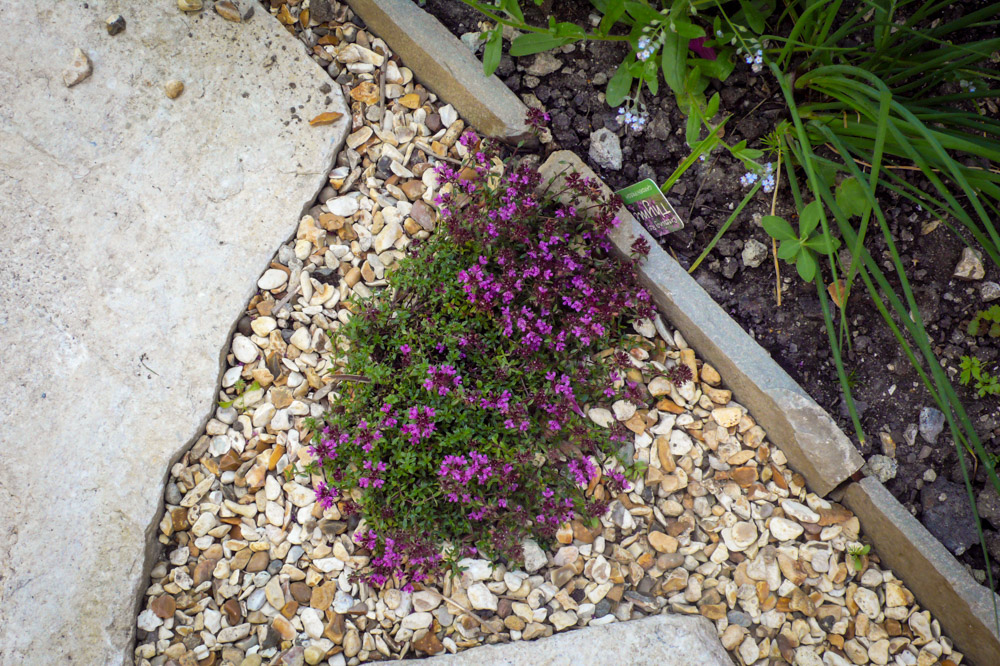
Rocket and cut-and-come-again lettuce were ready for eating, along with all the herbs that had been biding their time before we left them. The thymes, sisyrinchium and alchemilla mollis planted among the pavings were looking happy and the tiny plants poked into crannies in the walls had put on weight and were trailing or blooming. Self-seeded nasturtiums had started to flower, as had the cosmos and antirrhinums(given the Chelsea chop in May) that had been put into spaces to give us some colour in our first year.


Now the new plants are finding their feet, I can imagine which ones will need to be moved in the autumn, and where I need to bring in plants of a different height, habit or colour. I am hoping that at the end of the season I shall be able to split some plants that seem to like these conditions and have spread enough to be divided. So far I don't have the problem of plants becoming too big for their spaces; next year, perhaps, or the year after.


We have been enjoying meals in the garden, taking in the scent of dianthus and roses, looking forward to the scent of honeysuckle and night-scented stocks in the next few weeks. I must savour the moment, and not constantly cast my eye from one place to another, anticipating the little jobs (weeding, dead-heading, pruning) to be done tomorrow.
 

Sunday, 7 June 2015

Auriculas

“They are much more like pets than plants,”Patricia Cleveland-Peck, author of The Auriculas of Spitalfields

acknowledgement to www.albion-prints.com
I've always fancied the idea of an auricula theatre. I'm not, in general, one for formal displays, but somehow theses little primulas, with their wide-eyed, turned-up faces appeal, and the theatre has proved itself the ideal display venue over the years. Native to the alps of central Europe, auriculas have been known as cultivated plants in England since Elizabethan times. To begin with, they were confined to the gardens of the wealthy, but during the 18th and 19th centuries, gardeners (florists) of all kinds began to grow and to show them. These shows were known as feasts, and the flowers, (also tulips, polyanthus, carnation, pink, hyacinth, anemone and ranunculus) known as floristry flowers. The emphasis was on perfection at close quarters.


 The right opportunity arose when Piers discovered an old stone shelf as he formed the new garden shapes. It faces north-west and is about 8” deep – not exactly a theatre, but good for displaying auriculas, never the less.


I don't know anything about auriculas, so I sought out Pop's Plants, a specialist nursery on the edge of the New Forest. There we found Gill and Lesley. We made our way through their cottage and across the narrow, pretty garden to an enormous, hidden, open shed. There was a roof, but it was made of green netting to shade the plants, which were set out on extensive waist-high benches. Tiny plants as far as the eye could see – thousands of them. Gill and Lesley hold 4 national collections and raise their own plants for sale and to show.


The encounter was a delightful education! Gill told us how they raise the plants (no micro-propagation here) and breed them. The various types of plant (alpine, border, double, striped, show edged, show fancy and show selfs) and a few of the dos and don'ts. Bright but not too sunny. Moist but not too wet. We came away with 7 'easy-to-grow' 'alpines' and a 'border', two still in flower and the rest to surprise us with a range of colour next year. Another stipulation was to remove offsets in order to give a nobler, more showy plant.


I shall be experimenting with these offsets to see if I can populate the edges of the garden with these fussy little prima donnas and have them edging the paths as they would have done in the 19th century back-to-backs of Lancashire.


Exciting times

Suddenly the garden in Dorset has come together. The builders have finished with this bit of the property and have taken away the last of the rubble, sand and tools that were stacked tidily (for builders) across one corner. Piers got to work, and in two days had finished the walling. I told him that the back-ache was worth it, but at the moment he doesn't believe me.


I started the remaining planting. I appreciate design in a garden, and I don't think that I have really achieved it here. To some extent that is deliberate. We have the structure provided by the surrounding walls, the courtyard paving and gravel, and now the new, low rock-walling.


Also, the existing climbers (not yet completely tamed), the Acer and Viburnum. Having decided on a cottage style, the emphasis is on many shapes and colours, so within the framework that we have in place, I can put in pretty much anything that isn't too highly bred.


I am aiming for a patchwork of dainty forms and colours that will give interest during the parts of the year when it is pleasant to be outside. I'm not quite sure what will work in the long run, so I have often bought only one of a particular type of plant, and will wait to see how it likes its new home and whether or not it bulks up and I can split it in the autumn.


There are plants that I simply cannot live without – London Pride, Aquelegia, anemone nemorosa, Japanese anemones, foxgloves, for example. Will they like it here? When the greenhouse is built I shall have scope for raising plants that take my fancy and fill a niche. I'm sure nature will help me to bring rhythm to this little space.


Forget me nots


'Just how many forget-me-nots do you need?' Dee

We travel to France in early May, after winds and rains. The horizon is pencil-defined and blue, the sky awash with clouds of every shape. As we near the village, the fields are a patchwork of greens, punctuated by the yellow of oilseed rape, the vineyards showing the green of leaves above the twigs of the vines. The copses (left for the chasseurs and their game) are full of texture, with laburnum and guelder rose adding colour.


We enter the gate of our house and the garden hits us. Burgeoning is not a word to be used lightly, and here it is an understatement. Everywhere there is growth. The growth I had hoped for and the growth that comes on its own. If one wants a free-flowing, abundant garden, one must pay for it with the plants that come unbidden - in other words, weeds.


After a long drive, Piers grabs some crémant and I grab some tools. It is a perfect evening for gardening. The air is balmy and the soil is moist. He sits on the edge of the well as I use the fork to remove dandelions and docks from the dinosaur garden. Underneath a tree is a classic place to not plant grass, but under our Norwegian maple there is plenty of it. A whole bed (left 'empty' for the roofers) is covered in forget-me-not. I don't think Dee was right in her assumption. They look wonderful!


When the weeding is done I can asses the success of the last gardening trip. Some transplanted peonies are showing red buds and all the other introductions from last time look healthy. The weeds I can cope with if the chosen plants thrive as well.


New friends in France

Whoever makes a garden
Has oh so many friends:
The glory of the morning,
The dew when daylight ends

Anon

When you have a baby, suddenly everyone wants to be your friend. It's a bit the same between gardeners, and we have new friends in France. Cinda (an existing gardening friend!) said: 'Why not come along to Les Parterres en Kit at Fontenille, where they're holding a plant sale on Easter Monday?'. Great idea. We all went along, and met Lucia and Jos, a Dutch couple who have been living in France for about 8 years.


Lucia has hit on a plan. She is a fan of the English gardener and writer Michael King, who now lives in Holland. He advocates a new and more natural way of creating herbaceous borders and flower meadows, and Lucia has followed some of his planting plans, which she supplies in the form of plants (kits) to her French customers. She has tailor-made her choice of the plants she supplies to suit the calciferous clay soils and the extremes of temperature and rainfall of Burgundy. She has done the experiments so, hopefully, I don't have to. We came back from the plant sale with epimedium, Tricyrtis formosana, and aster to put into the existing beds.


Looking out at the garden from the house, snowdrops and winter aconites that were so pleasing a month ago have now gone. Daffodils, mostly not in their final places, are blooming well, but the glory of the garden at this time are the primroses and the hundreds of violets. Violets are everywhere on the verges and in gardens – it's a very good violet year – and they punch well above their tiny weight in terms of charming impact.


As we leave France, tulips are ready to bloom, hydrangeas, philadelphus, rose and hazel leaves are bursting and the
hypericum, Virginia creeper and cystus brought from England are finding their feet. I put rosemary and lavender temporarily between sturdy rose bushes in the hope that they will be safe from the tramping of the expected roofers. When we return in a month, the garden may be gently coming into its own, or it may be flattened and crying out for help, depending on whether or not the artisans have decided to turn up.